What do businesses have in common?
Outreach is essential to any budding business that doesn’t have a literal storefront.
Cold calling, email campaigns, flyering or door knocking.
What’s the one thing these have in common?
Time.
They consume time. Your time.
Any small business owner or entrepreneur will tell you this isn’t particularly fun.
Would you knock on doors and risk the wrath of a grumpy homeowner, or develop your next business idea?
Cold call and face being told to fuck off or build your next project?
Write boatloads of emails that will mostly never be opened or brainstorm with your partners how your idea will edge out the competition?
And with emails you have to weigh up how much extra time goes into personalising them with the potential reward of more responses.
Finding the companies or people that may need your services.
Finding their emails.
It’s a slow and laborious process.
Luckily it’s 2026 and AI and automation can do most of that for you.
How it works
In basic terms, an automation runs in the background, either on a schedule or when you trigger it. It finds companies that may benefit from your services, looks for relevant contact details, and drafts an email ready for you to review.
For the techy readers, our current version works like this:
- An API request triggers a Seek scraper through Apify, collecting Australian job listings based on the selected profession and location.
- The listings go to OpenAI. A strict prompt asks it to assess whether the responsibilities described suggest a realistic opportunity for BFdev’s automation services.
- The AI returns structured JSON containing the qualification decision, its reasoning, and evidence from the listing. JavaScript validates that response before the lead goes any further.
- For qualified leads, Hunter.io is used to look up the company’s domain and available business email addresses. The returned contacts are ranked to select a suitable person to approach.
- A second AI step takes the job role, location and supporting evidence, then uses an email template to draft relevant outreach. It briefly suggests how the work described could be automated to save time, reduce expenses or avoid errors.
For example, this listing describes managing course access, scheduling training bookings, raising purchase orders and maintaining records.
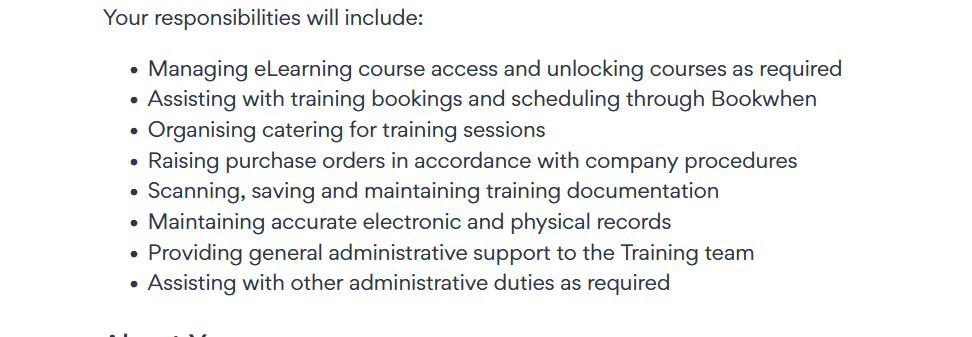
Those responsibilities give the system something specific to work with. Rather than firing out a generic sales pitch, the draft suggests automating access requests, booking updates and the filing of training documents.
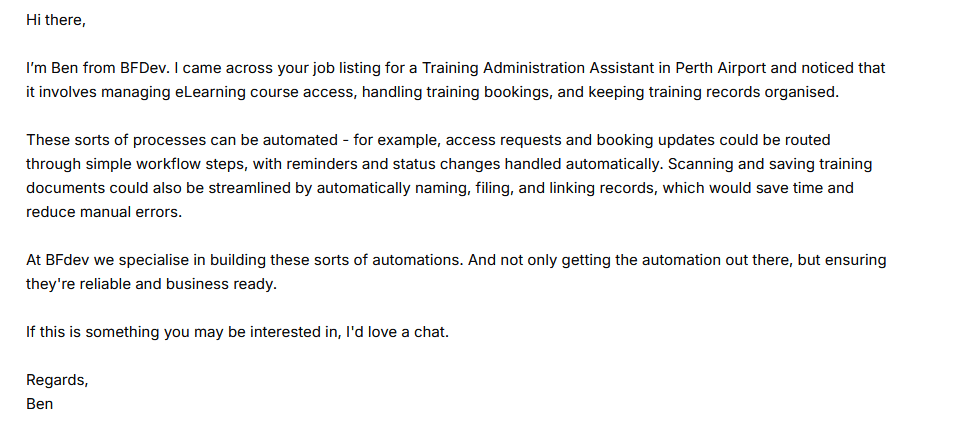
The draft then goes through another validation step, checking its structure, required wording and any unfilled placeholders, before being presented to the user for review.
The system prepares the outreach. You decide whether it’s relevant and worth sending.
The live demonstration on this site uses a simplified version of that workflow. It skips contact enrichment and returns a drafted email alongside the original job listing, so you can compare the two yourself.
How could this apply to you?
- Recruitment agencies: find employers advertising roles in their specialist area, qualify them by location and job type, and draft an introduction offering recruitment support.
- IT support providers: identify businesses hiring service-desk or infrastructure staff, then assess whether the advert suggests an opportunity for external support or additional capacity.
- Training providers: find companies recruiting for roles that require particular certifications or skills, and prepare outreach offering relevant training for new or existing staff.
- Payroll and bookkeeping firms: identify businesses hiring payroll or finance administrators, then draft an introduction focused on the specific work described in the listing.
- Marketing agencies: find businesses recruiting marketing staff and identify a relevant service—such as content production or campaign support—that could complement their internal team.
How can I rely on AI to do a human’s job?
One of the foundational principles of BFdev automations is AI guardrails.
The first and foremost is that, and you’d be forgiven for thinking otherwise given the current climate, it’s not as cut and dry as ‘AI doing a human’s job’.
AI is one tool in any workflow.
The lead generator doesn’t just hand something to AI and say ‘get the job done’.
The AI is utilised for its abilities, in this example, to interpret human language, and output writing.
Within strict guardrails. In the case of the lead generator these include:
- A strict prompt providing detailed instructions of how to treat the data it’s given—first the job listing, then the email template.
- Validating code, which adheres to deterministic rules with zero interpretation, assessing whether the output is within acceptable boundaries.
- Regular cross-examination of whether the interpretation of job listings is sound.
- A mechanism for ensuring the supposed opportunity for services matches the interpreted evidence from the listing.
The ability to scrape websites for information is one tool in our tech. As is the triggering of one workflow by an email or text message. So is AI for interpretation and classification.
Summary
This is a high-level explanation of the lead generator and it’s a far more complex system than this article details.
There's also a ton of room for customisation. You may want to filter companies by headcount or market value. You might want more detailed outreach. Maybe you want it to feed into the CRM you currently use for leads. This could also be integrated into a larger, more intelligent system that can learn from output.
So that's the lead generation. If this is something you'd want for yourself, or you just want to know more about how it works, get in touch with us on LinkedIn.